
The U.S. architecture industry continues to evolve with shifts in construction demand, technology adoption, and economic cycles. This report compiles the latest verified architecture industry statistics from IBISWorld, BLS, and global market research sources, structured to give a clear, factual view of the industry in 2026.
Architecture Industry Size
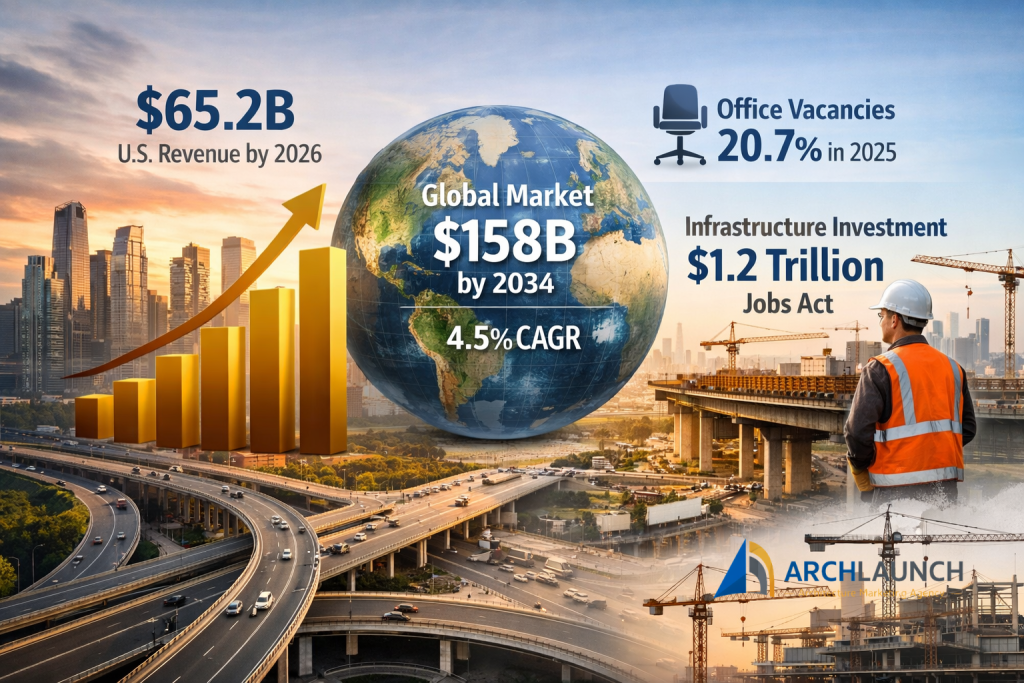
According to our architecture industry statistics, The U.S. architecture industry is projected to generate $65.2 billion in revenue in 2026, reflecting steady expansion. Over the past five years (2021–2026), the industry grew at a 2.1% compound annual growth rate (CAGR), with modest growth of 0.5% forecasted for 2026.
Globally, the architectural services market is much larger, estimated at $158 billion by 2034, growing at a 4.5% CAGR, highlighting long-term infrastructure and sustainability trends.
Despite overall stability, the industry has faced volatility due to macroeconomic factors. For instance, office vacancies reached 20.7% nationwide in 2025, and cities like San Francisco and Austin reported rates exceeding 26%, affecting demand in commercial sectors. Federal investment, such as the $1.2 trillion Infrastructure Investment and Jobs Act, has helped buffer the industry and generated growth opportunities in public-sector projects.
Architecture Workforce Statistics
The architecture profession in the United States employed 123,600 architects in 2024, according to the Bureau of Labor Statistics (BLS). According to the latest architecture industry statistics, this workforce is projected to grow 4% from 2024 to 2034, keeping pace with the average growth rate across all occupations.
On average, there will be about 7,800 job openings per year over the next decade. These openings are driven both by new demand for architectural services and by the need to replace architects who leave the workforce, retire, or transition to other occupations.
Architects work primarily in office settings, where they plan, design, and coordinate projects, but site visits remain an essential part of the role to ensure design plans are executed correctly. Entry into the profession typically requires a bachelor’s degree in architecture, completion of a paid internship, and successful passage of licensing exams.
This steady employment outlook reflects ongoing demand for architectural expertise across residential, commercial, and institutional projects, creating avenues for firms to generate more architecture leads while meeting workforce needs.
Key Facts – Architects in the U.S. (2024)
- Number of jobs: 123,600
- Median pay: $96,690 per year ($46.49 per hour)
- Employment growth (2024–2034): 4%
- Average annual openings: 7,800
- Typical entry-level education: Bachelor’s degree
- On-the-job training: Internship/residency
Architect Salary Statistics
Architect salaries in the United States vary significantly by location, experience, and sector. According to the U.S. Bureau of Labor Statistics (May 2024), the national median annual wage for architects is $96,690, with the top 10% earning more than $159,000.
Top Paying States for Architects (2024)
Based on state-level data, architects earn the highest median wages in the following areas:
- District of Columbia: $114,480
- Wyoming: $107,040
- Rhode Island: $106,950
- California: $105,840
- Alaska: $105,340
- Connecticut: $105,200
- South Dakota: $102,420
- Massachusetts: $101,980
- Nevada: $101,720
- Georgia: $100,870
Other states with strong median wages include New York ($98,580), New Jersey ($97,980), Texas ($85,770), and Florida ($83,720). These figures exclude self-employed architects, landscape architects, and naval/marine architects.
Insights on Salaries and Firm Revenue
- Median salaries are supported by steady demand across residential, commercial, and institutional projects.
- Compensation can vary by firm size and revenue per employee: large firms typically generate $200k–$250k per employee, while smaller firms average $100k–$150k per employee.
- Salary growth remains stable, reflecting consistent employment growth projected at 4% from 2024 to 2034, along with ongoing infrastructure and high-value project demand.
This data gives architects, students, and industry analysts a clear view of pay trends across the U.S., highlighting where compensation is highest and how firm size and sector affect earnings.
Fastest-Growing Architecture Sectors in the U.S.
While the overall U.S. architecture industry grows steadily, certain specialized sectors are experiencing accelerated expansion. These architecture industry statistics reflect changing societal needs, technological innovation, and large-scale public investment.
Healthcare Architecture Statistics: Designing for Wellbeing and Efficiency
Healthcare architecture is emerging as one of the most dynamic areas in the industry. The U.S. healthcare design market is projected to reach $11.9 billion by 2030, growing at a 5.2% CAGR. Expanding outpatient facilities, community clinics, and hospitals are driving demand for spaces that prioritize sustainability, operational efficiency, and patient wellbeing.
Firms such as HOK are at the forefront of this transformation. Their work on projects like the New Parkland Hospital in Dallas highlights how evidence-based design and energy-conscious strategies are setting new benchmarks. Across the country, healthcare projects increasingly focus on environments that support both staff efficiency and patient recovery, responding to rising demand, escalating costs, and sustainability goals.
Aviation Architecture Statistics: Modernizing U.S. Airports
Airport design is another sector experiencing rapid growth. Airports Council International estimates that the U.S. will require roughly $173.9 billion in airport infrastructure investment between 2025 and 2029, averaging $35 billion annually. This surge reflects rising air travel and the need for more efficient, sustainable, and technologically advanced terminals.
Gensler’s redesign of JFK Airport’s New Terminal One in New York exemplifies this trend. Projects like this focus on passenger flow, digital integration, and environmental sustainability. As airports expand to meet future demand, aviation architecture is becoming a critical driver of innovation and revenue in the U.S. architectural landscape.
Data Centre Architecture Statistics: Building the Digital Backbone
Once a niche area, data centre design has grown into a high-demand sector. The U.S. data centre construction market is expected to grow at a 10.2% CAGR through 2030, reaching more than $150 billion in value. The rise of AI, cloud computing, and digitalization across industries is fueling this growth.
Leading firms such as Corgan and HDR are designing facilities that balance technical performance with environmental responsibility. Key priorities include energy efficiency, heat reuse, and renewable energy integration. Data centre architecture now plays a pivotal role in supporting the infrastructure of the digital economy.
Educational Architecture: Creating Modern Learning Environments
Schools and universities are redefining the spaces in which students learn, making educational architecture a rapidly evolving field. Investment in public infrastructure enables architects to design learning environments that encourage collaboration, creativity, and wellbeing.
Perkins & Will’s Smithsonian Institution Bezos Learning Centre in Washington D.C. demonstrates how modern educational architecture integrates digital learning, green spaces, and interactive environments. These projects show that architecture can shape not just spaces, but also how students learn and interact, setting the standard for the next generation of educational design.
Civic and Public Infrastructure Statistics: Architecture for Community Impact
Public infrastructure investment, particularly through the $1.2 trillion Infrastructure Investment and Jobs Act (IIJA), is driving growth in civic architecture. According to the latest architecture industry statistics, public projects contribute roughly $29.7 billion annually to the U.S. architecture market, covering transport hubs, libraries, community centers, and cultural venues.
Modern civic projects prioritize accessibility, sustainability, and long-term adaptability. Architects are now designing facilities that are energy-efficient, socially impactful, and capable of meeting evolving community needs. This surge in public works is creating new opportunities across the U.S. architectural sector, reinforcing the importance of socially responsible design.

Key Takeaways
The 2026 U.S. architecture industry statistics shows steady growth, stable employment, and emerging opportunities in specialized sectors:
- Industry revenue: Projected at $65.2 billion in 2026, reflecting consistent expansion across the U.S. market.
- Workforce: 123,600 licensed architects employed in 2024, with total openings averaging 7,800 per year over the next decade.
- Compensation: Median annual wage for architects is $96,690, with the top 10% earning more than $159,000; salaries vary by state, firm size, and project focus.
- High-Paying States: Top earners are concentrated in D.C., Wyoming, Rhode Island, California, and Alaska.
- Fastest-Growing Sectors: Healthcare, aviation, data centres, educational facilities, and civic/public infrastructure are driving accelerated demand.
- Public Investment: Federal initiatives, such as the $1.2 trillion Infrastructure Investment and Jobs Act, support growth in civic and infrastructure projects.
- Technology & Innovation: Firms are increasingly integrating sustainability, digital tools, and evidence-based design into projects to improve efficiency and user experience.
Overall, the U.S. architecture industry statistics show that the industry remains resilient, with stable salaries, growing specialized sectors, and public investment providing opportunities for firms to innovate and expand in 2026 and beyond.
Sources Used:
- https://www.ibisworld.com/united-states/industry/architects/1401/
- https://www.bls.gov/ooh/architecture-and-engineering/architects.htm
- https://www.csgtalent.com/insights/blog/u-s–architecture-market-trends–the-fastest-growing-sectors-and-regions/
- https://www.kbvresearch.com/healthcare-architecture-market/
- https://www.globalgrowthinsights.com/blog/architecture-industry-2025-growth-u-s-tariff-impacts-and-strategic-shifts-761
- https://www.grandviewresearch.com/industry-analysis/architectural-services-market
- https://inside.lighting/news/25-06/ranked-top-paying-states-architects-salary-usa