
The architectural services market has become a critical pillar of global economic and urban development. At ArchLaunch, our team has compiled and analyzed key industry statistics and market reports to better understand how urban expansion, infrastructure development, and sustainability priorities are reshaping the sector. Architectural services now sit at the intersection of design, technology, and long-term planning.
Market Landscape and Growth Outlook
In 2025, the global architectural services market was valued between USD 398.33 billion and by the end of 2026, the market is projected to grow to USD 411.43 billion, depending on the report, reflecting its massive global footprint. Additionally, this market is projected to grow steadily over the next decade, reaching USD 622.04 billion by 2033–2034, driven primarily by rising construction activity, rapid urbanization, and infrastructure investment worldwide.
Urbanization alone underscores the scale of this transformation. In 2025, cities accounted for roughly 45% of the global population, with around 3.7–3.8 billion people living in urban areas. With most population growth expected to occur in cities through 2050, demand for architectural services is expected to remain strong and sustained.
Architectural Services Market Size and Forecast
The architectural services market demonstrates consistent growth across all major reports, with only slight variations in projections due to methodology differences.
| Metric | Value |
| Market Size (2025,2026) | USD 398.33B – USD 411.67B |
| Estimated Market Size (2026) | USD 390.12B – USD 430.91B |
| Forecast (2031) | USD 505.03B |
| Forecast (2033–2034) | USD 605.62B – USD 622.04B |
| CAGR | ~5.0% to 5.3% |
This steady growth trajectory reflects the essential role architecture plays across sectors such as residential housing, infrastructure, healthcare, and commercial development. At a regional level, the United States alone is expected to reach approximately $158 billion by 2034, highlighting the scale of mature markets, even as emerging economies drive faster growth rates globally.
Key Drivers of Growth in the Architectural Services Market
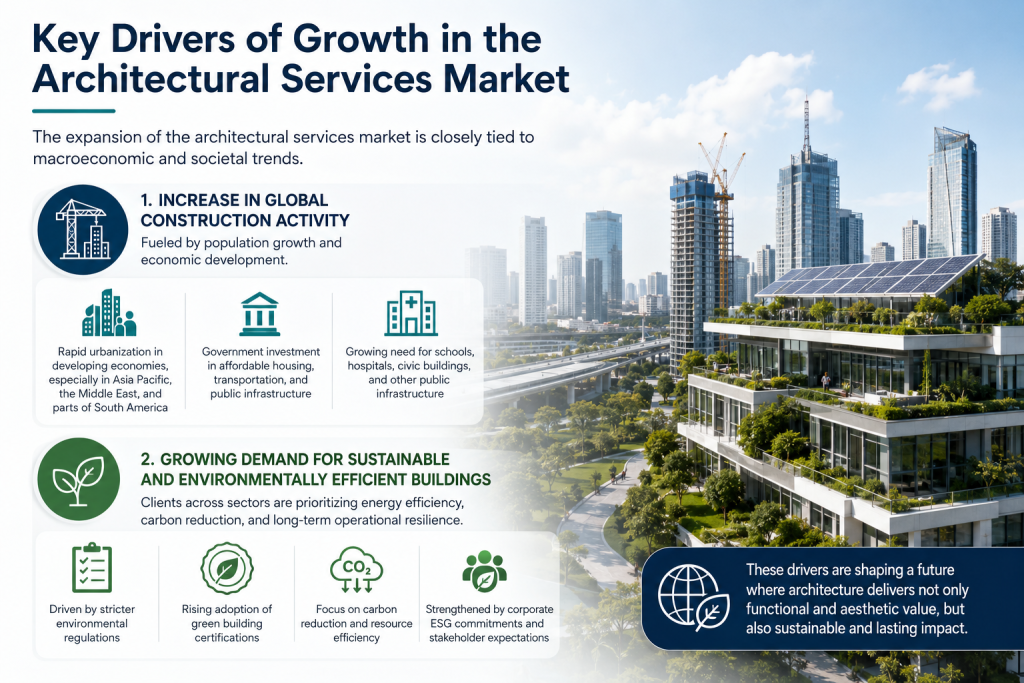
The expansion of the architectural services market is closely tied to macroeconomic and societal trends. The most significant driver remains the increase in global construction activity, fueled by both population growth and economic development. Rapid urbanization in developing economies, particularly in Asia Pacific, the Middle East, and parts of South America, has accelerated demand for residential buildings, commercial spaces, and infrastructure projects. Governments are also playing a central role by investing heavily in affordable housing, transportation systems, and public infrastructure such as schools, hospitals, and civic buildings.
Another major driver is the growing demand for sustainable and environmentally efficient buildings. Clients across sectors are prioritizing energy efficiency, carbon reduction, and long-term operational resilience. This shift is reinforced by environmental regulations, green building certifications, and corporate ESG commitments.
Technology Transforming Architectural Services
Technology is fundamentally reshaping how architectural services are delivered. Tools such as Building Information Modeling (BIM), virtual reality (VR), generative AI, and digital twins are no longer optional, they are becoming core components of modern architectural workflows. These technologies enable architects to improve efficiency, reduce errors, and deliver more precise designs. For example, generative AI can analyze multiple design variations within seconds, optimizing factors such as material use, energy efficiency, and cost. In some cases, firms report productivity gains of up to 31% during the schematic design phase.
BIM adoption continues to grow globally, with advanced integrated environments expected to expand at a faster rate than traditional modeling approaches. In markets such as Singapore, BIM utilization has reached as high as 90%, setting a benchmark for digital transformation in architecture. At the same time, digital tools are enabling better collaboration across project stakeholders and improving transparency throughout the project lifecycle.
Sustainability and Smart Design Trends
Sustainability has become one of the most influential forces shaping the architectural services market. Across regions, clients are demanding buildings that meet strict environmental standards, including energy efficiency, water conservation, and reduced carbon emissions. This shift is reflected in the growing adoption of green building certifications such as LEED and BREEAM, which are increasingly considered essential rather than optional. Several major trends are driving this transformation:
- Increased demand for net-zero and low-carbon buildings
- Growing use of sustainable materials and lifecycle analysis
- Expansion of smart city initiatives
- Integration of climate-resilient design principles
In addition, modular and prefabricated construction is gaining traction as a faster and more efficient alternative to traditional building methods. These approaches can reduce construction timelines by 30% to 50%, while also improving quality control and minimizing waste.
Market Segmentation: Services, End Users, and Project Types
The architectural services market is diverse, spanning multiple service categories and industries. Understanding how revenue is distributed provides insight into where the greatest opportunities lie.
By Service Type
| Segment | Key Insight |
| Design & Documentation | Largest share (~40.92%) |
| Construction & Project Management | ~32 to 34% share, core to project execution |
| Urban Planning | Fastest-growing segment (~6.28% CAGR) |
| Engineering & Interior Design | Strong demand across complex projects |
Construction and project management services play a crucial role in coordinating large-scale developments, while urban planning is expanding rapidly due to the rise of smart cities and sustainable urban design.
By End User
| Segment | Share / Growth |
| Residential | ~34.21% share |
| Industrial & Manufacturing | Fastest growth (~6.12% CAGR) |
| Government & Education | Strong CAGR driven by public investment |
| Healthcare | Steady growth due to demographic trends |
Residential construction remains the largest segment, supported by housing demand, while industrial and infrastructure projects are expanding quickly due to global investment in manufacturing and logistics.
By Project Type
| Project Type | Insight |
| New Construction | Dominates (~53.98% share) |
| Adaptive Reuse | Fast growth (~5.98% CAGR) |
| Renovation & Retrofit | Increasing due to sustainability goals |
While new construction continues to lead, adaptive reuse and retrofitting are gaining momentum as cities prioritize sustainability and cost efficiency.
Regional Insights – Where Growth is Concentrated
The architectural services market varies significantly by region, with both mature and emerging markets contributing to global growth.
| Region | Key Highlights |
| Asia Pacific | Largest or fastest-growing (~33 to 37% share) |
| North America | Up to 39.14% share, driven by infrastructure spending |
| Europe | Growth driven by sustainability and retrofitting |
| Middle East & Africa | Large-scale infrastructure and smart city projects |
| South America | Growth supported by urban expansion |
Asia Pacific stands out as the primary growth engine, fueled by rapid urbanization, population growth, and large-scale infrastructure development. Meanwhile, North America remains a dominant market due to strong federal investment and technological adoption.
Europe’s market is shaped by stringent environmental regulations and a focus on energy-efficient building design, while the Middle East continues to invest heavily in ambitious infrastructure and smart city initiatives.
Challenges and Market Constraints
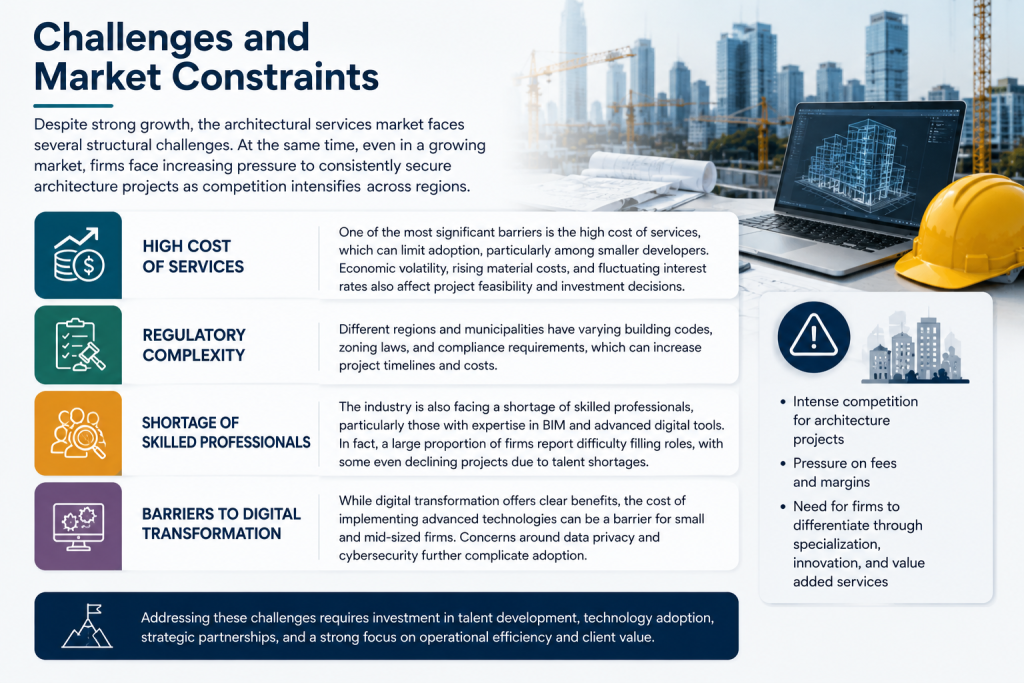
Despite strong growth, the architectural services market faces several structural challenges. At the same time, even in a growing market, firms face increasing pressure to consistently secure architecture projects as competition intensifies across regions. One of the most significant barriers is the high cost of services, which can limit adoption, particularly among smaller developers. Economic volatility, rising material costs, and fluctuating interest rates also affect project feasibility and investment decisions.
Regulatory complexity presents another major challenge. Different regions and municipalities have varying building codes, zoning laws, and compliance requirements, which can increase project timelines and costs. The industry is also facing a shortage of skilled professionals, particularly those with expertise in BIM and advanced digital tools. In fact, a large proportion of firms report difficulty filling roles, with some even declining projects due to talent shortages.
Additionally, while digital transformation offers clear benefits, the cost of implementing advanced technologies can be a barrier for small and mid-sized firms. Concerns around data privacy and cybersecurity further complicate adoption.
Conclusion
The architectural services market is set for steady, long-term growth, supported by global trends in urbanization, infrastructure development, and sustainability. With a projected value exceeding USD 600 billion by the early 2030s, the industry is becoming increasingly central to how cities and societies evolve.
Looking ahead, the future of architecture will be shaped by three key forces: technology, sustainability, and urban expansion. Firms that successfully integrate digital tools, adapt to environmental requirements, and navigate complex regulatory environments will be best positioned to capture market share.
As demand continues to rise across sectors, from residential housing to advanced industrial facilities, architectural services will remain essential in designing the built environment of the future, while also influencing how firms think about growing an architecture firm.
Sources:
- https://www.grandviewresearch.com/industry-analysis/architectural-services-market
- https://www.fortunebusinessinsights.com/architectural-services-market-113729
- https://www.csgtalent.com/insights/blog/u-s–architecture-market-trends–the-fastest-growing-sectors-and-regions/
- https://www.mordorintelligence.com/industry-reports/architectural-services-market