
Few industries blend creativity with commerce quite like interior design. Behind the mood boards and material swatches lies a fast-moving global market shaped by shifting work habits, rising sustainability demands, and rapid technological change. Interior design statistics reveal an industry far larger and more complex than most people realize — one quietly reshaping how we live, work, and spend.
This article breaks down the numbers driving that story. You’ll find global market size projections, regional growth breakdowns, workforce data, salary figures, and emerging trend indicators, all drawn from leading research firms. Whether you’re a designer, investor, or simply curious about the industry’s scale, what follows gives you a clear, data-backed picture of where things stand today. For firms focused on architectural marketing, numbers like these, along with broader architecture industry data, reveal where demand is growing and where the real opportunities lie.
Global Market Size & Revenue
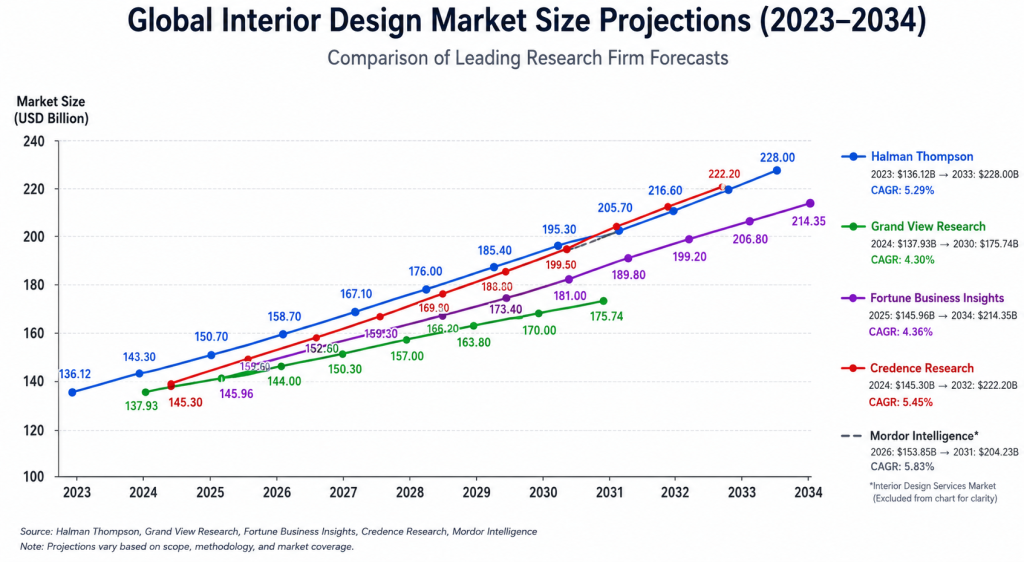
These interior design statistics vary significantly in long-term forecasts, similar to how architectural services market trends differ depending on whether sources measure design services revenue, total project spending, or broader construction-linked activity.
- The global interior design market was valued at $136.12 billion in 2023 and is expected to surpass $228 billion by 2033, growing at a CAGR of 5.29%. (Halman Thompson)
- An alternative projection places the global market at USD 137.93 billion in 2024, expected to reach USD 175.74 billion by 2030 at a CAGR of 4.3%. (Grand View Research)
- Fortune Business Insights valued the market at USD 145.96 billion in 2025, projecting growth to USD 214.35 billion by 2034 at a CAGR of 4.36%. (Fortune Business Insights)
- Credence Research estimates the market at USD 145.3 billion in 2024, forecast to reach USD 222.2 billion by 2032 at a CAGR of 5.45%. (Credence Research)
- The interior design services market specifically stood at USD 153.85 billion in 2026 and is forecast to reach USD 204.23 billion by 2031 at a CAGR of 5.83%. (Mordor Intelligence)
Country & Regional Market Revenue
United States
- The US interior design services market generated approximately $25.9 billion in 2024, while the broader home decor and furnishings market exceeded $35 billion. (Halman Thompson; First Chair)
- The US market is projected to reach $41.7 billion by 2030. (First Chair)
- The US accounted for approximately 83.21% of North America’s regional revenue in 2023. (Grand View Research)
United Kingdom
- The UK interior design industry generated estimated revenues of £1.6 billion in 2024, with activities revenue forecast to reach £1.9 billion by 2025–26 at a 3% CAGR. (Halman Thompson; Asdav)
- UK interior design activity is expected to grow 2% in 2024–25 after declining 1.1% between 2019 and 2024. (Halman Thompson)
- There are 6,352 interior design businesses operating in the UK. (Halman Thompson)
Regional Market Share
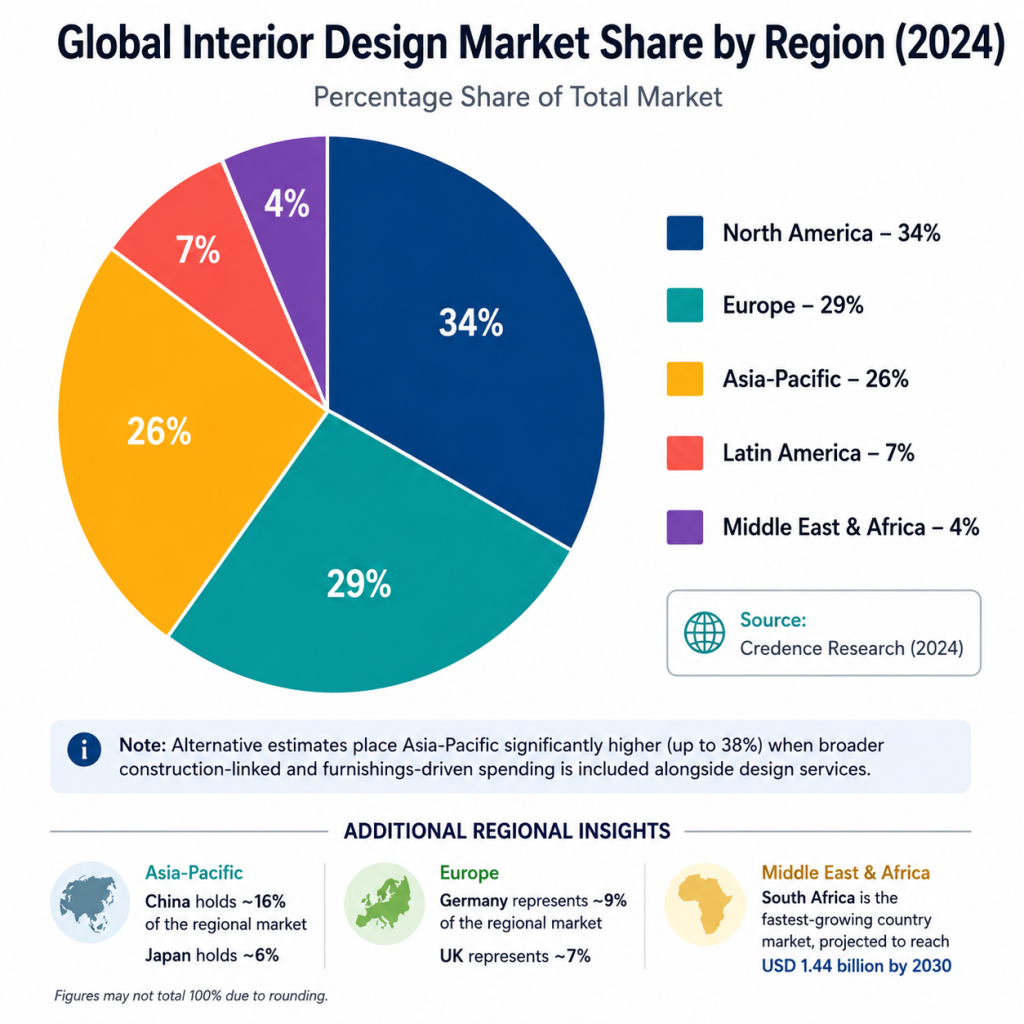
North America currently leads the global interior design market, though Asia-Pacific is rapidly closing the gap and represents the highest long-term growth opportunity.
| Region | 2024 Market Share |
| North America | 34% |
| Europe | 29% |
| Asia-Pacific | 26% |
| Latin America | 7% |
| Middle East & Africa | 4% |
Sources: Credence Research
Note: Alternative estimates place Asia-Pacific significantly higher (up to 38%) when broader construction-linked and furnishings-driven spending is included alongside design services.
Additional regional data:
- Within Asia-Pacific, China holds approximately 16% of the regional market, while Japan holds around 6%. (Fortune Business Insights)
- Within Europe, Germany represents approximately 9% and the UK around 7% of regional market share. (Fortune Business Insights)
- South Africa is the fastest-growing country-level market, projected to reach USD 1.44 billion by 2030. (Grand View Research)
Market Segmentation
By End User
Residential projects still account for the majority of the market by volume, but commercial design is the fastest-growing segment by CAGR.
| Metric | Residential Share | Source |
| Interior design services revenue (2025) | 57.39% | Mordor Intelligence |
| Broader interior design ecosystem spending | ~42% | Fortune Business Insights |
| Total project volume / design activity | 60%+ | Credence Research |
Sources: Mordor Intelligence, Fortune Business Insights, Credence Research
Note: Variations reflect whether estimates measure fee revenue, project activity, or total design-linked spending including procurement and furnishings.
Key highlights:
- The residential segment accounted for over 60% of the global market in 2024 across all design activities. (Credence Research)
- Living room design led application segments with approximately 30% share in 2024. (Credence Research)
By Project Type
- Renovation and remodeling accounted for 47.85% of the interior design services market in 2025 and is growing at an 11.78% CAGR through 2031. (Mordor Intelligence)
- New construction generated USD 95.33 billion in 2024, representing the single largest revenue segment globally. (Grand View Research)
- In 2024, interior design project mix broke down as: 48% new construction, 45% renovation, and 7% cosmetic refresh. (Asdav)
- The remodeling segment is projected to grow at a CAGR of 5.3% from 2024 to 2030. (Grand View Research)
By Service Type
- Full-service interior design was the largest service category, representing over 40% of the market in 2024. (Asdav)
- The mid-range price tier held 53.37% of the interior design services market in 2025. (Mordor Intelligence)
- Premium and luxury interior design services are the fastest-growing tier, projected to expand at a CAGR of 13.84% through 2031. (Mordor Intelligence)
By Product Category
Furniture, furnishings, lighting, and flooring collectively represent the four dominant product spending in interior design statistics:
| Product Category | Share of Spending |
| Furniture | ~35% |
| Furnishings | ~25% |
| Lighting | ~22% |
| Flooring | ~18% |
Source: Fortune Business Insights; First Chair
Furniture represented approximately 35% of product-category spending. When combined with fixtures and equipment, total FF&E accounted for roughly 50% of overall project expenditure — overtaking construction costs for the first time in 2024. (Asdav)
Top Interior Design Firms
United States
- There are approximately 157,000–160,000 interior design businesses in the United States, the majority of which are sole proprietorships or small independent studios. BLS employment figures track formally employed designers rather than all registered entities. (Halman Thompson; First Chair)
- The top 100 interior design firms crossed USD 5 billion in combined fees for the first time in 2023, then grew to USD 6.3 billion in 2024 — a 7% year-over-year increase. (Asdav)
- The top 100 firms completed more than 83,000 projects in 2024, up from ~81,000 in 2023. (Asdav)
| Company | 2024 Revenue |
| Gensler | $206.2 million |
| Interior Architects Inc. | $188.6 million |
| Hok Group, Inc. | $158.0 million |
| Aecom | — |
Sources: Halman Thompson; Fortune Business Insights
United Kingdom
| Company | Forecasted 2025 Revenue |
| Loop Interiors International Ltd | £52.1 million |
| Claremont Group Interiors Ltd | £35.6 million |
| GA Design International Ltd | £9.7 million |
Source: Halman Thompson
Sector-Specific Revenue (2025)
The breakdown below reflects fee revenue generated by design work within specific commercial sectors:
- Workplace design: $1.52 billion (First Chair)
- Healthcare design: $945 million (First Chair)
- Hospitality design: $602.7 million (First Chair)
Industry Trends & Growth Drivers
Sustainability & Eco-Design
Sustainability is becoming a structural driver of the industry rather than a niche preference, with green building certifications and eco-friendly materials influencing design briefs at scale.
- The eco-friendly furniture market was valued at $43.26 billion in 2022 and is projected to grow at an 8.6% CAGR through 2030. (Halman Thompson)
- The sustainable interior design market is forecast to reach $100 billion, representing a roughly 30% increase within a few years. (Halman Thompson)
- Interface Inc. has achieved a 96% reduction in greenhouse gas emissions across its manufacturing operations since 1996. (Credence Research)
- ESG-linked green building certifications contribute an estimated +1.1% uplift to interior design market CAGR forecasts. (First Chair)
Technology & AI
- The global interior design software market is expected to reach $8.6 billion by 2025. (Halman Thompson)
- AI-enabled space planning has delivered cost reductions of up to 75% in complex design environments. (Mordor Intelligence)
- Generative AI visualization tools add an estimated +0.6% to industry-wide CAGR projections. (First Chair)
As competition increases, understanding how firms attract clients in competitive markets becomes just as important as adapting to technological change.
Post-Pandemic & Hybrid Work
The shift to hybrid working arrangements has created sustained demand for workspace redesigns, residential upgrades, and flexible commercial environments. Looking at interior design statistics, this trend stands out as one of the most consistent growth drivers shaping the industry today.
- Hybrid work programs have employees averaging 2.9 days on-site per week in 2025, maintaining elevated demand for thoughtful workplace environments. (Mordor Intelligence)
- Post-pandemic hybrid work trends are estimated to add +1.2% to interior design CAGR forecasts. (First Chair)
- Corporate office design declined 5% year over year in 2024 and remains 18% below 2019 levels, reflecting ongoing uncertainty in office occupancy strategies. (Asdav)
- By contrast, transportation sector design surged 38% year over year in 2024. (Asdav)
Additional Macro Drivers
- Rapid urbanization in Tier-2 Asian cities is estimated to contribute +0.9% to CAGR. (First Chair)
- Wellness-oriented materials and biophilic design trends add +0.8% to CAGR projections. (First Chair)
- The UK Government’s £4.8 billion Levelling Up Fund for infrastructure and building renovation is expected to indirectly stimulate demand for interior designers. (Halman Thompson)
Home Decor Market
The broader home decor market is closely related to, but distinct from – the interior design services market, capturing consumer spending on furnishings, decorative items, and home accessories.
Market Size Over Time (Global)
| Year | Market Revenue |
| 2018 | $101.22 billion |
| 2020 | $108.71 billion |
| 2022 | $122.41 billion |
| 2023 | $128.31 billion |
| 2024 | $133.62 billion |
| 2025 (forecast) | $139.05 billion |
| 2029 (forecast) | $161.68 billion |
Source: Halman Thompson
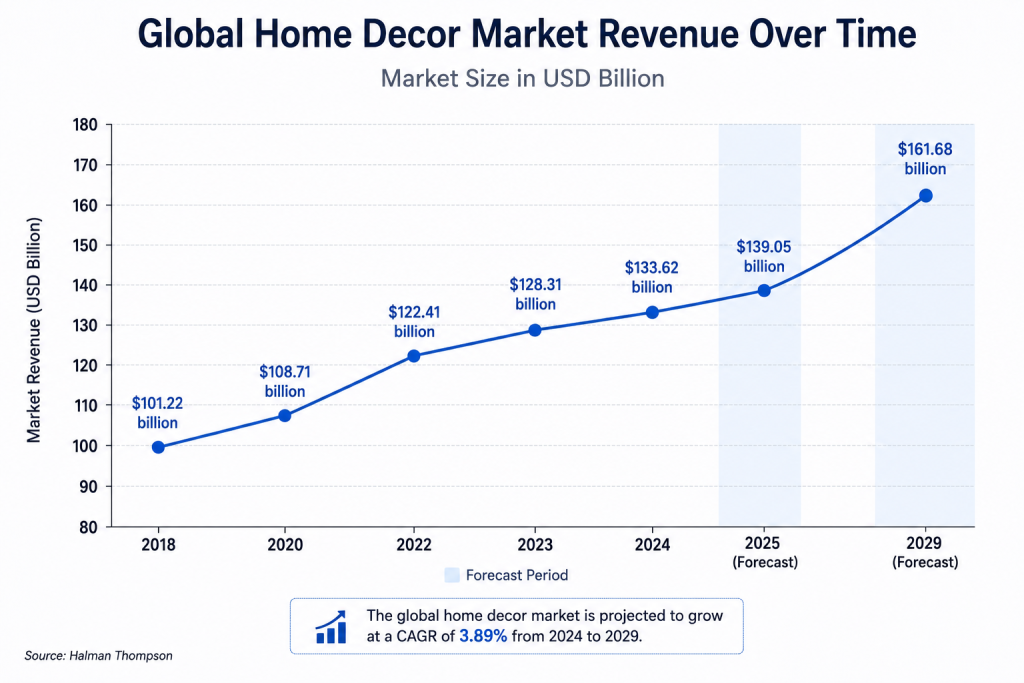
- The global home decor market is projected to grow at an annual rate of 3.89% between 2024 and 2029. (Halman Thompson)
- The US leads the home decor market, generating $35 billion in 2024. (Halman Thompson)
- The UK home decor market generated £3.6 billion in 2024, with projected annual growth of 1.48% through 2029. (Halman Thompson)
- The top countries by home decor revenue in 2024 are the United States, China, Germany, Japan, and Canada. (Halman Thompson)
Online Home Decor
Digital channels are growing significantly faster than the overall market, driven by improved visualization tools and shifting consumer buying behavior.
- The online home decor market grew from $5.34 billion in 2023 to $5.97 billion in 2024 — an increase of 11.8%. (Halman Thompson)
- The segment is expected to maintain a 12.24% annual growth rate, reaching an estimated $12 billion by 2030. (Halman Thompson)
Home Decor Product Categories
| Category | Projected Revenue by 2029 |
| Furniture (global market) | $546 billion (as of 2022 baseline) |
| Carpets & Rugs | $58.50 billion |
| Curtains | $53.65 billion |
| Decorations | $36.38 billion |
| Candles | $13.15 billion |
Source: Halman Thompson
Workforce & Employment
Employment Scale
The interior design workforce in the US is fragmented between employed designers and independent practitioners.
- Interior designers held approximately 87,100 jobs in 2024 per BLS data, though broader workforce estimates including principals and support staff suggest around 128,800 total designers working in the US. (First Chair)
- About 55% are employed and 45% work independently. (First Chair)
- 33% of interior designers work in specialized design services, 21% are self-employed, and 15% work in architectural or engineering services. (First Chair)
- California has the highest concentration of interior design firms (1,536) and the largest designer workforce (9,420). (Foyr)
- The top US states for interior designers are California, Florida, New York, Texas, and Missouri. (Foyr)
Job Growth Outlook
- Employment in interior design is projected to grow 3% from 2024 to 2034, generating approximately 7,800 job openings annually. (First Chair; Asdav)
- Specialized interior design sectors (e.g., healthcare, transportation) could see employment growth as high as 20% over the next decade. (Foyr)
- The US construction industry will require an estimated 439,000 net new workers in 2025, placing pressure on related design disciplines. (Mordor Intelligence)
Salaries & Compensation
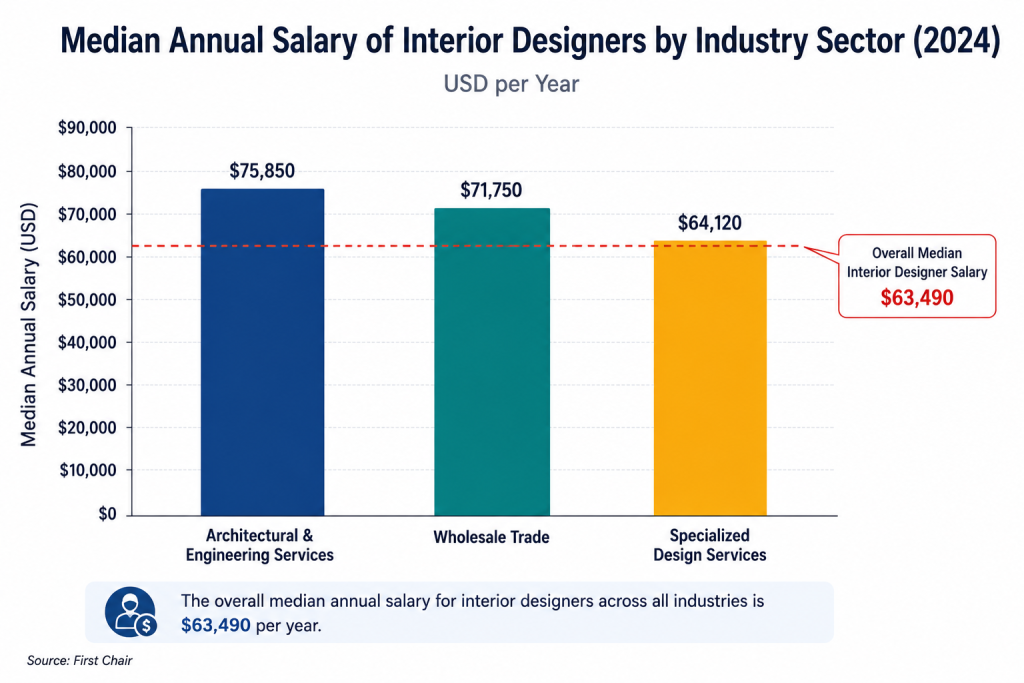
- The median annual salary for interior designers was $63,490 in 2024 (approximately $30.52 per hour). (First Chair)
- The bottom 10% of earners made less than $38,480, while the top 10% exceeded $106,090. (First Chair)
- The average salary across all experience levels reached $69,958 in 2023, an 11.3% increase year over year. (First Chair)
| Industry Sector | Median Annual Salary |
| Architectural & Engineering Services | $75,850 |
| Wholesale Trade | $71,750 |
| Specialized Design Services | $64,120 |
Source: First Chair
Demographics & Workforce Diversity
The interior design profession remains heavily female-dominated and has historically shown limited racial and ethnic diversity.
- Nine out of ten working interior designers are women. (Foyr)
- In 2023, 84% of interior designers identified as women, with 81.1% identifying as White. (First Chair)
- Additional racial composition data (2019): Caucasian 73%, Asian 8%, Hispanic 7%, African American 3%. (Foyr)
- The average age of professional interior designers falls in the 40+ bracket. (Foyr)
- A Bachelor’s degree in interior design typically takes 3–4 years, while an Associate’s degree requires 2 years. (Foyr)
Company Spotlight
- Livspace has completed over 75,000 home interior projects across multiple Asian cities, illustrating the scale of demand in emerging markets. (Credence Research)
- Leadership roles across the top 100 US firms surged 18% in recent years, even as “other” interior design employee categories fell 26%, resulting in an overall 11% net staff reduction — suggesting a shift toward leaner, senior-heavy teams. (Asdav)
Key Takeaways
- The global interior design market is on a clear upward trajectory, with most credible estimates pointing to a market value of $175–$228 billion by 2030–2033.
- Asia-Pacific leads in broader construction-linked and furnishings-driven interior spending by some estimates, and is expected to drive the most growth through the decade.
- The Middle East & Africa region, while small in absolute terms (~4% share), is the fastest-growing market with a projected 17.33% CAGR.
- Renovation and remodeling now rival new construction in market share and are growing faster, driven by aging housing stock and post-pandemic home investment.
- Premium and luxury design services are growing at nearly 14% annually, well above the overall market average.
- The online home decor channel is expanding at over 12% per year, signaling a structural shift in how consumers discover and purchase design products.
- AI and sustainability are the two macro forces most likely to reshape the industry’s cost structure and client expectations over the next five years.
Conclusion
The picture that emerges from these interior design statistics is one of an industry with serious momentum. Residential demand remains strong, luxury services are growing faster than the overall market, and forces like AI and sustainability are quietly reshaping how design gets done. This isn’t a niche creative field anymore — it’s a global economic force worth hundreds of billions of dollars.
Ultimately, whether you’re a working designer, a business owner, or someone tracking broader market trends, the data offers a clear signal. The industry is evolving quickly, and the opportunities within it are growing alongside it.