
The architecture job market in the United States is defined by a relatively small workforce, strong educational barriers, and steady but modest long-term growth. There are approximately 123,600 architects employed in the U.S., with a median annual wage of $96,690 in 2024.
While demand remains positive, growth projections vary across datasets, from about 1% to 4.8% over the next decade, a pattern also reflected in broader architecture industry statistics, indicating a stable but highly competitive profession shaped by both economic cycles and technological change.
Architecture Job Market Size & Employment Landscape
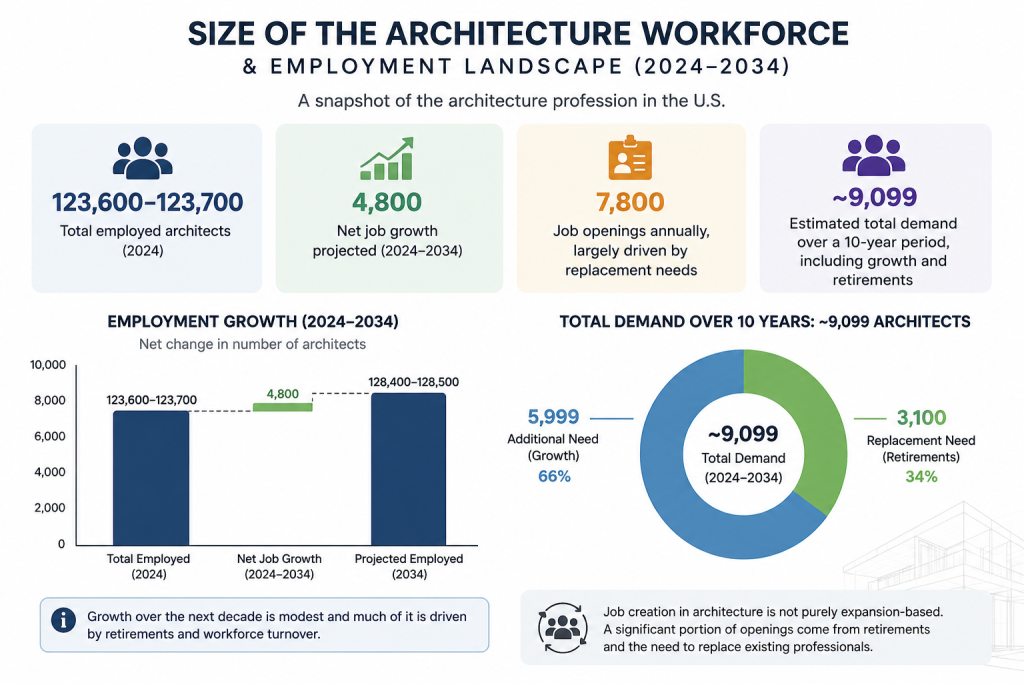
The architecture profession represents a niche segment of the broader labor market, with:
- 123,600–123,700 total employed architects (2024)
- Approximately 4,800 net job growth projected (2024–2034)
- Around 7,800 job openings annually, largely driven by replacement needs
- Estimated total demand of ~9,099 architects over a 10-year period, including both growth and retirements
Much of the job creation in the sector is not purely expansion-based but instead linked to workforce turnover and retirement cycles.
Salary Distribution for Architects in the United States
Architect compensation varies significantly based on experience, location, and specialization.
- Median annual salary: $96,690
- Hourly equivalent: $46.49
- Lower 25% earn approximately: $76,110
- Upper 25% earn approximately: $123,300
- Average base pay (alternate dataset): $86,500
- Entry-level licensed salaries: around $60,000
- Senior and management roles can exceed $160,000 annually
- Architecture internships average around $27,000 per year
This wide range reflects a career path with gradual income progression tied closely to licensing and experience.
Job Outlook and Long-Term Growth Trends
The architecture job market outlook remains positive but uneven depending on methodology and time period.
- 1% growth (2019–2029 projection)
- ~3.9%–4% growth (2024–2034 projection)
- 4.8% growth (2022–2032 projection)
Across sources, architecture is consistently described as growing at or slightly below the average rate for all occupations. Key drivers of demand include:
- Replacement of retiring workers
- Housing, schools, and infrastructure development
- Regional population growth patterns
At the same time, improved productivity from design technology, alongside overall architectural market growth trends, is limiting the need for large workforce expansion.
Geographic Distribution of Architecture Jobs
Architecture jobs are heavily concentrated in major U.S. economic and construction hubs. Top employment states include:
Other notable states include Florida, Illinois, Pennsylvania, Washington, Colorado, and Massachusetts. This concentration highlights a key feature of the profession: opportunities are unevenly distributed and closely tied to regional development activity.
Education, Licensing, and Career Entry Requirements
Becoming an architect requires a long and highly structured pathway that typically begins with a bachelor’s degree in architecture, which often takes around five years to complete. After graduation, candidates must complete a paid internship or residency period to gain practical experience in the field.
This is followed by passing a professional licensing exam and meeting state-specific registration requirements in order to practice legally as a licensed architect. Even after licensure, continuing education is required to maintain professional standing. In many cases, this education and training sequence is extended further by postgraduate study, making architecture one of the more time-intensive career paths compared to many other professions.
Demand vs Supply Imbalance in the Architecture Job Market
Despite steady job creation, the architecture field faces a persistent imbalance between graduates and available positions.
- Estimated demand: ~9,099 architects over 10 years
- Applications often exceed available roles significantly
- Example market pressure: up to 140 applications per graduate vacancy (UK data)
- Entry-level roles may receive 100+ applications within days
This imbalance is amplified by the long training pipeline, which produces a continuous flow of graduates entering a limited number of entry-level positions.
Key Challenges Reshaping the Architecture Job Market
Several structural forces are reshaping how the architecture labor market functions:
Entry-Level Hiring Constraints
Architecture firms are increasingly selective when hiring junior talent, often prioritizing experienced candidates over short-term trainees. This makes it more difficult for new graduates to secure their first roles and begin the traditional pathway toward full professional qualification.
Project Uncertainty
Fluctuations in project pipelines also affect hiring decisions. When developments are delayed or postponed, firms tend to reduce recruitment activity or pause expansion plans, limiting available positions even when long-term demand remains stable. This dynamic highlights how critical it is to understand how architecture firms sustain project pipelines in order to maintain consistent hiring and growth.
High Graduate Supply
A consistently large number of architecture graduates enter the job market each year. This steady pipeline increases competition for a limited number of entry-level roles, intensifying pressure on new professionals seeking to break into the industry.

Technology and Automation
Advancements in BIM, digital design tools, and computational workflows have significantly improved productivity across the profession. At the same time, AI and automation are reducing the need for repetitive junior-level tasks, lowering overall demand for entry-level staffing in some areas of practice.
Construction Market Fluctuations
Broader construction industry cycles also influence architecture employment. For example, a reported 38% drop in UK housebuilding in Q1 2025 compared to 2024 highlights how downturns in development activity can directly impact hiring and project availability.
Together, these factors create a more competitive environment for new entrants despite stable long-term employment totals.
Conclusion
The architecture job market remains structurally stable, but increasingly competitive at the entry level. While long-term demand continues to exist, access to opportunities is shaped by rising competition, shifting hiring practices, and the growing impact of technology on workflows.
Overall, architecture remains a viable long-term career path, but success, especially when growing an architecture firm in a competitive market, is increasingly determined by specialization, experience, and adaptability to changing industry conditions.
Sources used:
- https://subcusa.com/architecture-jobs-outlook-heres-what-to-expect-in-coming-years/
- https://www.nhbc.co.uk/insights-and-media/news/new-home-registrations-rise-in-q1-with-developers-encouraged-by-government-focus-on-housing-reports-nhbc
- https://www.dezeen.com/2025/08/11/architecture-graduate-job-market/
- https://www.careerexplorer.com/careers/architect/job-market/
- https://careers.usnews.com/best-jobs/architect
- https://www.bls.gov/ooh/architecture-and-engineering/architects.htm