
Home remodeling remains one of the largest segments of the U.S. residential construction industry, driven by aging housing stock, changing homeowner needs, and ongoing investments in existing homes. These patterns are closely tied to broader architecture industry statistics that reflect long-term demand across residential design and construction sectors.
From kitchen and bathroom renovations to roofing, HVAC, and energy-efficiency upgrades, remodeling activity provides valuable insight into how homeowners are improving their properties and where they are spending their money.
This report compiles the latest home remodeling statistics on market size, renovation spending, project popularity, return on investment (ROI), homeowner preferences, and industry trends.
Home Remodeling Statistics – Key Findings
Here are some of the most important home remodeling statistics:
- Americans spent an estimated $603 billion on home remodeling projects in 2024.
- The U.S. home remodeling market reached $503 billion in 2024.
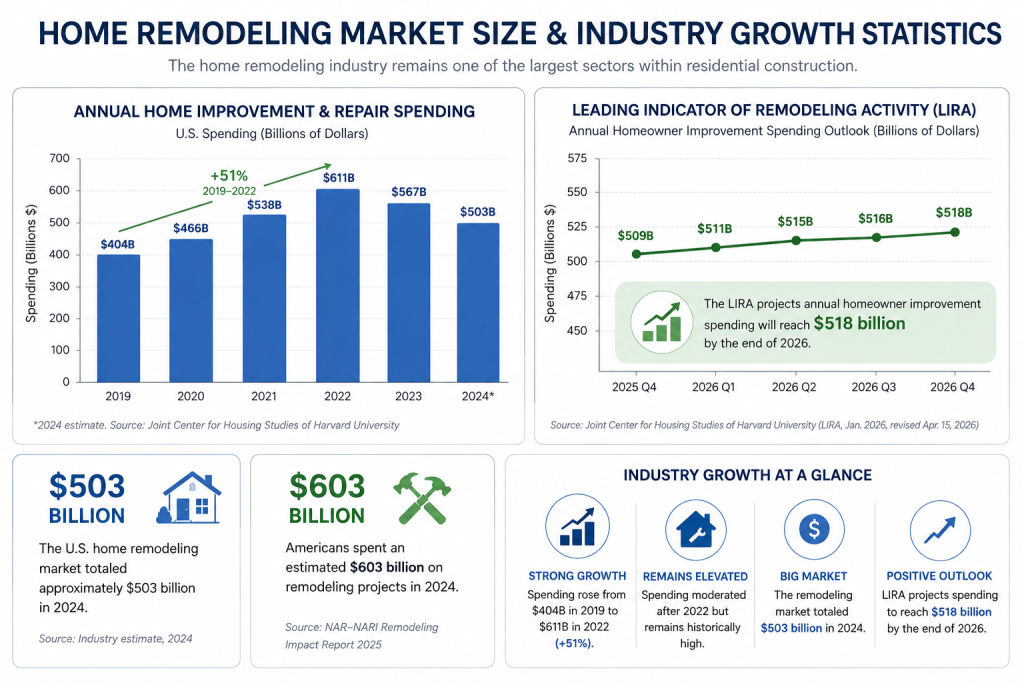
- Home improvement and repair spending increased from $404 billion in 2019 to $611 billion in 2022.
- Annual homeowner improvement spending is projected to reach $518 billion by the end of 2026.
- Median homeowner renovation spending was $20,000 in 2024.
- The top 10% of remodelers spent $140,000 or more on projects.
- 54% of homeowners completed a remodeling project in 2024.
- Kitchens and guest bathrooms were the most commonly remodeled rooms, each renovated by 24% of homeowners.
- Plumbing upgrades were completed by 27% of renovators, making them the most common system-related project.
- 91% of homeowners hire professionals for remodeling projects.
- Garage door replacements generated as much as 268% ROI, making them one of the highest-return remodeling investments.
- Minor kitchen remodels delivered approximately 113% ROI.
- 64% of homeowners reported a greater desire to spend time in their home after remodeling.
- 92% of homeowners said they would remodel additional areas if cost were not a factor.
Home Remodeling Market Size and Industry Growth Statistics
The home remodeling industry remains one of the largest sectors within residential construction.
According to housing industry research, spending on home improvements and repairs increased dramatically during the last several years. Annual spending rose from $404 billion in 2019 to $611 billion in 2022, driven largely by increased homeowner investment in existing properties.
Although growth has moderated since the peak years of pandemic-era remodeling activity, spending remains historically elevated. The U.S. home remodeling statistics market totaled approximately $503 billion in 2024, while Americans spent an estimated $603 billion on remodeling projects during the same year. These trends align with broader shifts in architectural market size and growth trends, where demand for residential design and renovation work continues to evolve alongside housing supply constraints and aging building stock.
Industry forecasts suggest continued growth rather than contraction. The Leading Indicator of Remodeling Activity (LIRA) projects annual homeowner improvement spending will reach $518 billion by the end of 2026.
Growth rates are expected to remain positive but slower than in previous years:
- 2.1% year-over-year growth projected for mid-2026
- 1.6% growth projected by late 2026
Researchers note that remodeling activity remains closely tied to broader housing market conditions. Modest improvements in single-family home sales and permitting activity are expected to support continued renovation demand.
Another defining characteristic of the remodeling industry is its fragmentation. Small contractors continue to dominate the market, and no single company controls a significant share of overall remodeling revenue. Even the largest remodelers collectively account for a relatively small portion of total professional spending.
From an architectural perspective, sustained remodeling demand reflects the growing importance of adapting existing housing stock rather than relying solely on new residential construction. Aging homes, deferred maintenance, and evolving homeowner expectations continue to generate opportunities for renovation and redesign.
Homeowner Remodeling Activity Statistics
Remodeling activity remains widespread among U.S. homeowners. In 2024, 54% of homeowners completed a remodeling project, only slightly below the 56% recorded the previous year.
Research shows homeowners are increasingly focused on improving the performance and usability of their homes rather than simply making cosmetic updates. The most common reasons homeowners undertook remodeling projects include:
| Reason for Remodeling | Share of Homeowners |
| Upgrade worn-out surfaces, finishes, and materials | 27% |
| Improve energy efficiency | 19% |
| Time for a change | 18% |
| Planning to sell within two years | 18% |
| Add features and improve livability | 8% |
| Modernize the home | 5% |
These motivations also reflect how remodeling decisions increasingly intersect with interior design market size and trends, particularly in areas such as spatial planning, finishes, and aesthetic upgrades that go beyond structural improvements. Industry professionals also report strong demand. Among remodeling contractors:
- 42% reported increased demand for remodeling projects during the previous two years.
- 57% reported larger project scopes or multi-room renovations.
Interestingly, housing affordability appears to be a less significant motivator than commonly assumed. While rising home prices and mortgage rates have made moving more difficult for some households, 89% of consumers reported housing affordability was not a deciding factor in their remodeling decisions.
Instead, many homeowners appear focused on improving existing homes to better meet their current needs. For architects and residential designers, these findings suggest that functionality, modernization, and long-term livability are becoming primary drivers of renovation activity.
Home Renovation Spending Statistics
Homeowners continue to allocate substantial budgets toward remodeling projects. Median renovation spending reached $20,000 in 2024, up from $18,000 in 2021, though lower than the $24,000 median recorded in 2023.
While median spending provides a useful benchmark, high-end projects continue to account for a significant share of industry expenditures. In 2024:
- The top 90th percentile of homeowners spent a median of $140,000.
- More than half of renovating homeowners previously reported spending $25,000 or more on renovations.
- Top-tier spending reached $150,000 among high-budget projects.
Longer-term spending trends are even more striking. Research found that median renovation spending increased approximately 60% between 2020 and 2023, rising from $15,000 to $24,000.
High-spending homeowners increased their renovation budgets even more aggressively. Spending among the top 90th percentile rose approximately 77% during the same period, increasing from $85,000 to $150,000.
These figures demonstrate that remodeling projects have become larger, more complex, and more expensive over time. For architecture firms involved in residential renovations, increasing project budgets may reflect greater homeowner willingness to invest in comprehensive redesigns rather than isolated improvements.
Most Popular Home Remodeling Projects Statistics
While spending levels vary significantly by household and project type, several remodeling categories consistently attract the highest homeowner interest. Among interior remodeling projects completed in 2024, kitchens and guest bathrooms tied as the most popular renovation projects, with 24% of homeowners upgrading each space.
The most commonly remodeled interior spaces were:
| Interior Remodeling Project | Share of Homeowners |
| Kitchen | 24% |
| Guest Bathroom | 24% |
| Primary Bathroom | 22% |
| Living Room | 18% |
| Guest Bedroom | 14% |
| Closet | 13% |
| Laundry Room | 13% |
| Primary Bedroom | 13% |
| Dining Room | 12% |
| Home Office | 10% |
Beyond room renovations, homeowners invested heavily in core building systems and infrastructure.
The most common system upgrades included:
| System Upgrade | Share of Renovators |
| Plumbing | 27% |
| Electrical | 25% |
| Automation Systems | 22% |
| Heating Systems | 22% |
| Cooling Systems | 21% |
| Security Systems | 21% |
These statistics suggest homeowners are increasingly focused on improving how homes function rather than concentrating solely on aesthetics.
Replacement-focused projects also continue to account for a significant share of spending. Industry research found that roofing, windows, HVAC systems, and other replacement-related improvements represented nearly half of all home improvement expenditures.
Home Remodeling Statistics by Room Costs
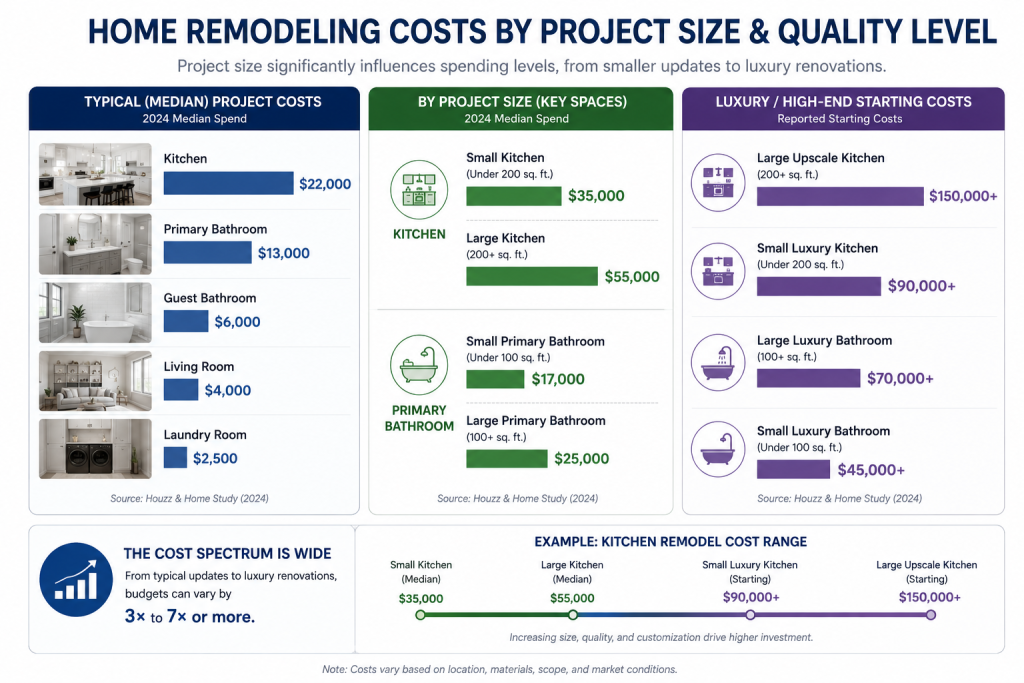
Remodeling costs vary significantly depending on project scope, room size, and quality level. Among common residential renovation projects, kitchens remain the most expensive room homeowners regularly remodel. Median spending by room in 2024 included:
| Room | Median Spend |
| Kitchen | $22,000 |
| Primary Bathroom | $13,000 |
| Guest Bathroom | $6,000 |
| Living Room | $4,000 |
| Primary Bedroom | $2,750 |
| Laundry Room | $2,500 |
| Dining Room | $2,100 |
| Closet | $1,500 |
| Guest Bedroom | $1,500 |
| Home Office | $1,000 |
Project size significantly influences spending levels. Large kitchens measuring more than 200 square feet carried a median remodeling cost of $55,000, while large primary bathrooms exceeded $25,000.
Smaller projects still represented substantial investments:
Luxury renovations commanded significantly higher budgets. Reported starting costs included:
- Large upscale kitchen: $150,000+
- Small luxury kitchen: $90,000+
- Large luxury bathroom: $70,000+
- Small luxury bathroom: $45,000+
The gap between median and luxury project costs demonstrates the wide range of renovation approaches available to homeowners, from modest refreshes to extensive architectural transformations.
Home Remodeling Statistics – ROI
Return on investment remains one of the most closely watched aspects of remodeling. While homeowners often remodel to improve functionality and enjoyment, many projects also generate substantial resale value.
Highest-ROI Remodeling Projects
Exterior upgrades delivered some of the strongest financial returns in 2025. The highest-performing projects included:
| Project | ROI |
| Garage Door Replacement | 268% |
| Steel Entry Door Replacement | 216% |
| Manufactured Stone Veneer | 208% |
| Fiber-Cement Siding Replacement | 114% |
| Minor Kitchen Remodel | 113% |
| Vinyl Siding Replacement | 97% |
| Wood Deck Addition | 95% |
Garage door replacements experienced particularly dramatic growth, increasing their return by 74% compared to the previous year.
Minor kitchen remodels remained one of the strongest-performing interior projects, generating a return exceeding 100%.
Cost Recovery Statistics
A separate remodeling analysis focused on cost recovery rather than ROI found the following projects generated the highest recovery percentages:
| Project | Cost Recovery |
| New Steel Front Door | 100% |
| Closet Renovation | 83% |
| New Fiberglass Front Door | 80% |
| New Vinyl Windows | 74% |
| New Wood Windows | 71% |
| Basement Conversion | 71% |
| Attic Conversion | 67% |
| Bathroom Renovation | 50% |
These findings reinforce a trend that appears throughout multiple studies: relatively modest upgrades frequently outperform large-scale luxury renovations when measured by resale value.
Projects With Declining ROI
Not every renovation generated stronger returns. Several projects experienced declining ROI in 2025:
| Project | ROI Change |
| Fiberglass Grand Entrance | -12.4% |
| Upscale Primary Suite Addition | -5.9% |
| Midrange Primary Suite Addition | -3.5% |
| Upscale Bathroom Remodel | -3.1% |
| Major Upscale Kitchen Remodel | -2.0% |
These declines suggest that rising project costs can sometimes outpace increases in home value, particularly for higher-end renovations. For architects and homeowners alike, the data indicates that targeted improvements often outperform extensive luxury remodeling when financial returns are the primary objective.
Homeowner Financing, Satisfaction, and Remodeling Preferences
Remodeling projects require substantial financial commitments, and homeowners use a variety of funding sources to pay for renovations. According to homeowner surveys, the most common financing methods included:
| Funding Source | Share of Homeowners |
| Home Equity Loan / HELOC | 54% |
| Savings | 29% |
| Credit Card | 10% |
| Other Loan Types | 4% |
| Gifts | 3% |
| Remodeler Financing | 3% |
Another study found that personal savings remained the dominant source of funding, used by 84% of renovating homeowners.
Who Completes Remodeling Work?
Professional involvement remains common despite ongoing interest in DIY projects. Among homeowners:
- 29% hired professionals for the entire project.
- 24% hired labor but purchased materials themselves.
- 24% completed the project entirely on their own.
- 22% contributed some DIY labor.
In another study, about 91% of homeowners reported hiring professionals for remodeling work overall. These findings indicate that while homeowners frequently participate in renovation projects, professional expertise continues to play a major role in project execution.
Remodeling Satisfaction Statistics
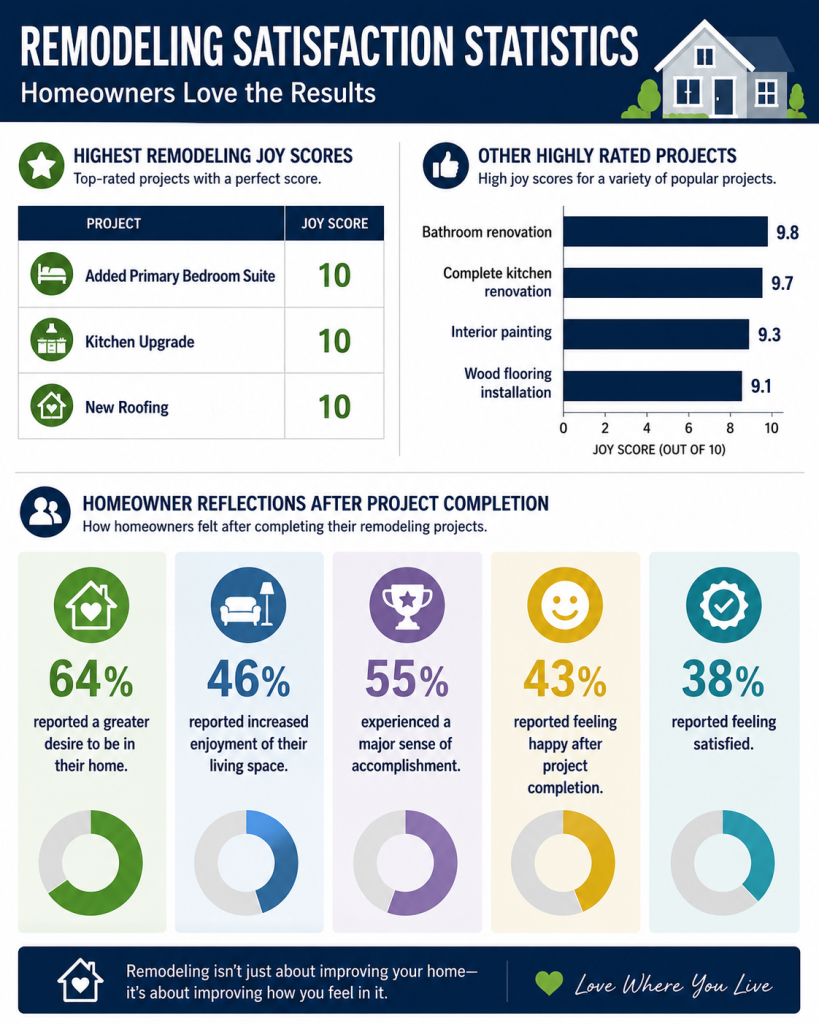
One of the most notable findings across multiple studies is the high level of homeowner satisfaction associated with remodeling. The projects with the highest remodeling joy scores included:
| Project | Joy Score |
| Added Primary Bedroom Suite | 10 |
| Kitchen Upgrade | 10 |
| New Roofing | 10 |
Other highly rated projects included:
- Bathroom renovation (9.8)
- Complete kitchen renovation (9.7)
- Interior painting (9.3)
- Wood flooring installation (9.1)
When homeowners reflected on completed projects:
- 64% reported a greater desire to be in their home.
- 46% reported increased enjoyment of their living space.
- 55% experienced a major sense of accomplishment.
- 43% reported feeling happy after project completion.
- 38% reported feeling satisfied.
When asked about the most important outcome of remodeling, homeowners identified:
| Outcome | Share |
| Better functionality and livability | 28% |
| Durable, long-lasting results | 23% |
| Beauty and aesthetics | 23% |
| Better meets household needs | 15% |
| Energy efficiency | 5% |
| Better resale value | 4% |
Perhaps most notably, 92% of homeowners said they would remodel additional areas of their home if cost were not a factor.
These findings suggest that remodeling delivers benefits that extend beyond financial returns, improving daily living experiences and overall satisfaction with the home.
Conclusion
Home remodeling remains a major part of the U.S. housing market, with homeowners continuing to invest heavily in renovations, repairs, and home upgrades. The latest data shows strong spending levels, steady remodeling activity, and continued demand for projects that improve functionality, energy efficiency, and long-term property value.
Kitchens, bathrooms, roofing, and other high-impact upgrades remain among the most popular remodeling investments. As housing stock continues to age and homeowners prioritize improving existing properties, remodeling is expected to remain a significant driver of residential design and construction activity.
Sources used: